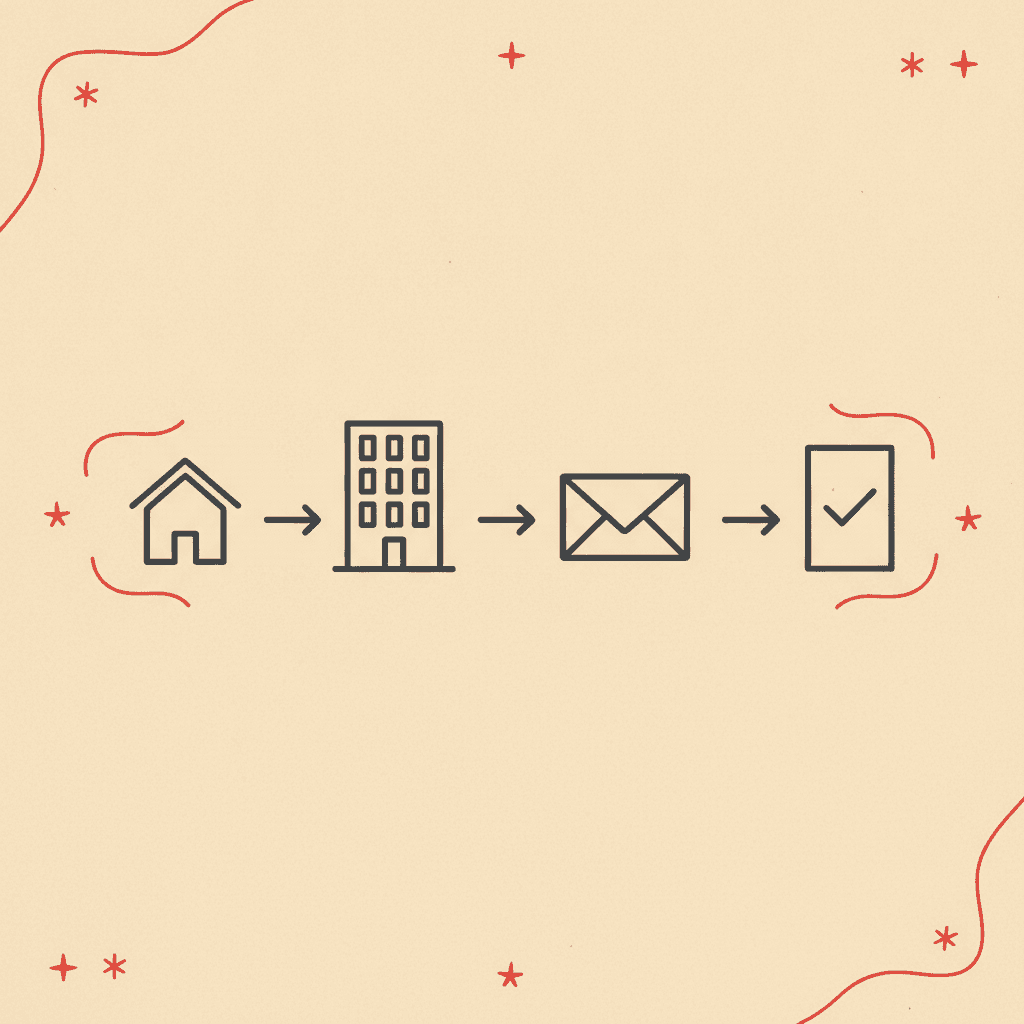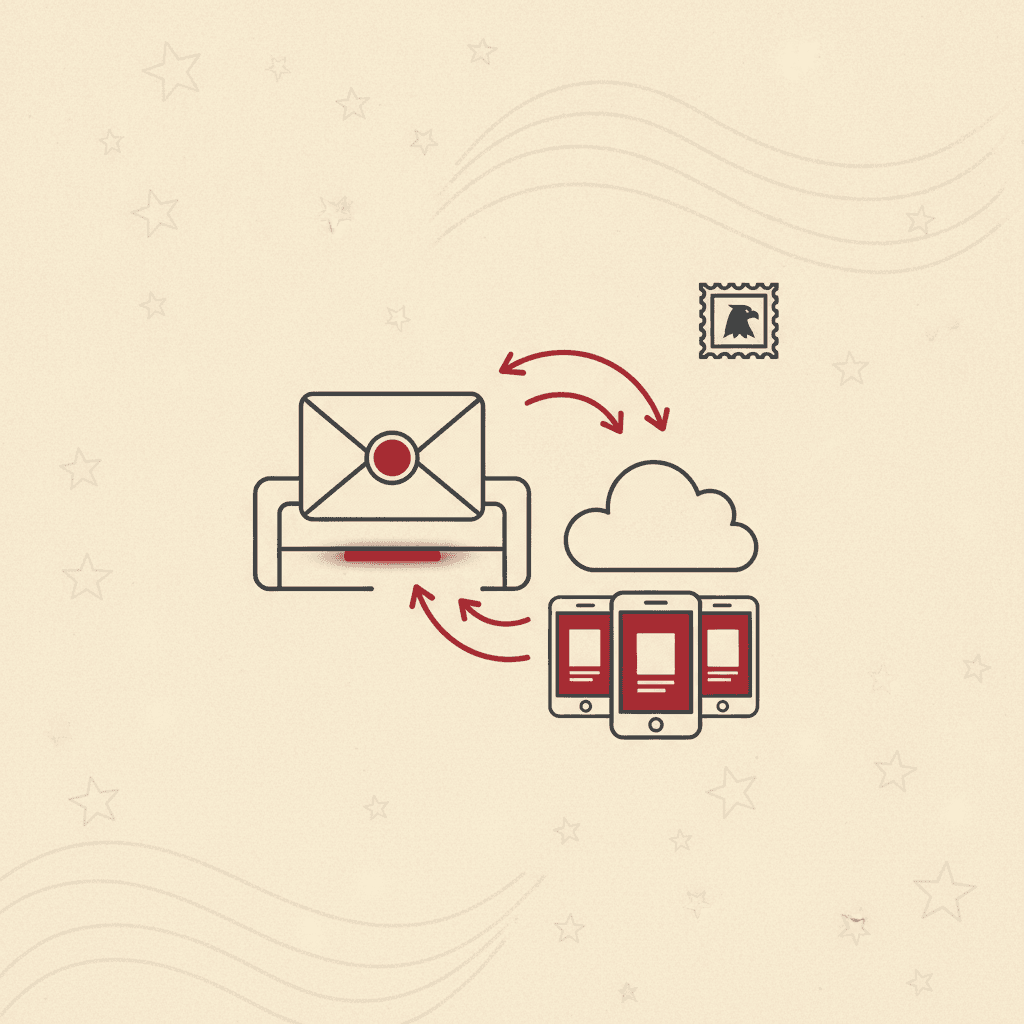
A virtual mailbox is a street address at a business that receives mail for others. USPS calls that business a Commercial Mail Receiving Agency (CMRA). Before mail can reach you, USPS rules require Form 1583. Then the company accepts each piece, and you choose online what happens next.
We followed one letter through that path. At each step we checked who handles the letter and which text sets the rule. Our sources were the USPS Domestic Mail Manual (DMM), PS Form 1583 and USPS Publication 28. Of the ten Google results we checked for this question, none of the snippets mention Form 1583 or the PMB rule. Both rules shape the first steps below.
What is a virtual mailbox?
The USPS pages we read describe no USPS product called a "virtual mailbox." USPS instead sets rules for the companies that offer one. DMM 508.1.8.1 defines the business:
"A Commercial Mail Receiving Agency (CMRA) is defined as a business that, in whole or in part, accepts the delivery of U.S. Mail on behalf of another person or entity as a business service. U.S. Mail is inclusive of all classes of mail."
Publication 28, the USPS addressing standard, puts the idea more simply: "Private companies offering mailbox rental services to individuals and businesses are considered commercial mail receiving agencies (CMRA)." The DMM then describes the basic job in one sentence:
"The CMRA accepts delivery of the mail and holds it for pickup or remails it to the addressee, prepaid with new postage."
A virtual mailbox adds a screen to that job. The CMRA section of the DMM mentions scanned mail once. In DMM 508.1.8.4, the customer must give "the remail address (or email if correspondence is scanned for digital delivery) on PS Form 1583." So the rules expect that some mail reaches customers as a scan by email.
What address do you get with a virtual mailbox?
You get the street address of the CMRA's building plus your own box number. USPS calls that box a private mailbox (PMB). DMM 508.1.8.3 sets the format:
"A CMRA must represent its delivery address designation for the intended addressees by the use of “PMB” (private mailbox) or the alternative “#” sign."
The USPS example puts your name on line 1 and the street address on line 3. Line 2 holds "“PMB” and number or the alternative “#” (pound sign) and number." The city, state and ZIP code go on the last line.
Three more USPS rules shape the address:
- No mixed numbers. You cannot merge the building's suite number with your box number. The DMM gives "10 MAIN ST STE 11-234" as the wrong form.
- No PO BOX wording. Publication 28 says "The words POST OFFICE BOX or PO BOX and the private mailbox number cannot be used on the Delivery Address Line."
- Missing box numbers can be sent back. USPS "may return mail without a proper address to the sender endorsed “Undeliverable as Addressed, Missing PMB or # Sign.”"
Publication 28 also has a note in its section on suite numbers: "Use of the pound sign might be prohibited when using a Commercial Mail Receiving Agency (CMRA) address with Private Mail Box (PMB) information." In our reading, writing "PMB" is the safer choice when you give out your address. Our post on whether your mailing address is a PO Box covers address formats in more detail. Whether a mailbox address reads as residential or commercial is a separate question, which we answer in is a virtual mailbox address residential or commercial.
What do you have to do before mail can reach you?
You complete PS Form 1583, now in its June 2024 edition. The form asks whether you want "Business/Organization Use" or "Residential/Personal Use." The form also requires two IDs: "One ID must be a government-issued photo ID. The second must confirm the Applicant’s or Authorized Individual’s address listed on this form." Current USPS rules let you sign in front of the CMRA or a U.S. notary, in person or by live audio and video. The CMRA must check your documents, and "If information on the application does not match the identification, the CMRA must deny the application." Each adult who gets personal mail at the box needs a separate form. Our posts on why Form 1583 gets rejected and what a CMRA is explain the paperwork. If several people will share one box, see how many people can use one virtual mailbox.
What happens when a letter arrives?
The carrier delivers your letter to the CMRA's building. The CMRA checks the name against the Form 1583 records it keeps. If no form exists for that name, the DMM sets the next step. The CMRA "must return that mail to the Post Office responsible for delivery," marked "Undeliverable, Commercial Mail Receiving Agency, No Authorization to Receive Mail for this Addressee."
After that check, USPS rules say little about how the company handles the letter. We counted words in the CMRA section of the DMM (section 508.1.8). The word "must" appears 63 times. The words "photo," "open" and "shred" appear zero times. In our reading, the DMM controls who may receive mail at the box. The DMM doesn't say how a company shows that mail to you.
The table follows one letter and marks where each rule comes from.
| Step | Who handles the letter | Where the rule comes from |
|---|---|---|
| Carrier delivers to the building | USPS | Delivery to the CMRA's street address |
| Name is checked against Form 1583 records | CMRA staff | DMM 508.1.8.4: no Form 1583 on file means return to the Post Office |
| You are told the letter arrived | CMRA staff | Company policy |
| Letter is opened and scanned | CMRA staff, if you ask | Company policy |
| Letter is sent on to another address | CMRA staff, if you ask | Form 1583 agreement: new postage required |
| Letter is kept, then destroyed | CMRA staff | Company policy |
At Auteur, every piece "gets an envelope photo when it arrives." Our fair use policy also says "Junk mail does not count. We filter obvious promotional mail for you, and it never uses up your plan." Other companies may work differently. A company may scan every letter by default, so read each company's policy before you choose.
What can you ask the mailbox to do with each piece of mail?
Form 1583 names the ways mail can leave the box. The form says to complete item 6 "if the mail addressed to this PMB is to be transferred, mailed, shipped, or emailed to another address." The most common requests are below.
Open and scan. At Auteur, "Opening and scanning is the one action we charge for: a flat fee per piece, only when you ask for it." The scan "comes back as a searchable PDF with Henry's summary and translation attached." Our policy notes limits too. We "cannot scan paper larger than 8.5 by 14 inches, documents over 1,000 pages, or bound items such as books and magazines."
Forward. Form 1583 includes an agreement that mail sent on "must be prepaid with new postage when redeposited in the mails." Our policy says "Forwarding costs the actual carrier postage and nothing else." Sending mail to another country has extra steps, covered in can I forward my US mail overseas.
Deposit a check. Some companies deposit checks for you. We explain how that works in can a virtual mailbox deposit checks. Whether a check needs an address at all is answered in do business checks need an address.
Shred. Shredding is included at Auteur when you are done with a piece.
What happens when a package arrives?
A virtual mailbox can accept packages, within each company's size and weight limits. Our limits are 25 pounds and 2 feet on each side. We cover packages in more detail in can a virtual mailbox receive packages.
How long does a virtual mailbox keep your mail?
Each company sets its own storage period. Our policy says "Everything physical, letters and packages alike, is stored for 30 days after it arrives." The policy adds "Legal and tax mail is never destroyed automatically: we contact you first, every time." Storage periods get a full post in how long do virtual mailboxes keep mail.
USPS rules do set what happens after you cancel. The CMRA "must remail mail intended for the addressee (customer) for at least 6 months after the termination date" of the relationship. Remailed mail needs new postage. The same rule lets you waive remailing: the duty "need not be fulfilled if the CMRA customer provides written instructions" not to remail. The DMM says this instruction may be part of your service agreement with the CMRA. The DMM also says "neither the addressee nor the CMRA will file a change-of-address order with the Post Office." So you tell senders your new address yourself. Our post on mail forwarding vs a virtual mailbox explains how USPS forwarding differs.
What can a virtual mailbox not do for you?
A virtual mailbox handles mail. Several jobs fall outside that role.
- Act as your registered agent. State laws generally have an LLC or corporation name a registered agent to accept service of process. Wyoming, for example, asks for a physical location where that agent, or someone acting for the agent, can accept it and is physically present. See can a virtual mailbox be your registered agent.
- Pay for deliveries. Our policy says "Cash-on-delivery shipments are refused at the door and returned by the carrier, since we cannot make payments on your behalf."
- Store food or cold items. "Perishable or refrigerated goods are disposed of, because our facility cannot store them safely."
- Run a parcel warehouse. Our service "is not a retail package-forwarding or parcel-consolidation depot."
- Act as a PO Box. "Only the Postal Service is entitled to provide delivery to a PO Box," says Publication 28. Our virtual mailbox vs PO Box post compares the two.
USPS rules also limit use. DMM 508.1.8.2 says a PMB "must not be used for, or in connection with, a scheme or enterprise that violates any federal, state, or local law."
Is a virtual mailbox safe to use?
We can't call any company safe. We can show the rules every CMRA must follow. The CMRA checks your two IDs and denies forms that don't match. The CMRA must "upload a clear and legible copy of each identification document into the USPS CMRA Customer Registration Database (CRD)." Every quarter, the CMRA must certify that each form "is current, all termination dates have been updated, and no identification documents are expired."
Company policy matters too. At Auteur, we open a letter only when you ask, or when you turn on automatic scanning. We summarize common problems customers report in virtual mailbox complaints.
Will the IRS and banks accept a virtual mailbox address?
Each agency and bank sets its own rules, and we don't promise any of them will accept a mailbox address. For the IRS, see how to change your LLC address with the IRS. For banks, see a business bank account without a physical address.
How an Auteur address works
We sell virtual mailboxes, so this is the seller's view. Auteur is in pre-launch, and your exact street address is assigned the day your city opens. We don't say any agency, bank or platform will accept our address. Each one may apply its own rules.
The Virtual Business Address receives mail in a business or trade name. Choose it if any of your mail comes to an LLC, a corporation or a DBA (doing business as) name. The Virtual Mailing Address is for personal mail, in individual names only. If you only need personal mail, see can I use a virtual mailbox for personal mail.
Both plans photograph the envelope of every piece as it arrives, and we open and scan only when you ask, for one flat fee per piece. Henry, our AI assistant, explains each letter you ask us to open. USPS rules require Form 1583 before any provider can receive mail for you. Pricing comes by email with the next steps, and our fees and limits are in our fair use policy.
If your mail comes to a company or DBA name, get your Virtual Business Address. Ordering is free, there's no card, and nothing is charged today. For mail in your own name only, the Virtual Mailing Address is the plan to choose.
This post explains USPS rules and our own published policy. The post isn't legal advice. Check each company's policy before you sign up.
FAQ
What are the pros and cons of using a virtual mailbox?
On the plus side, you get a street address and can see your mail from anywhere. USPS rules also require ID checks before a mailbox company receives mail for you. On the minus side, you must complete Form 1583 first, and each company sets its own fees and limits. Some agencies and banks may also refuse a mailbox address under their own rules.
Can you use a virtual mailbox as an address?
You can give out a virtual mailbox address for mail, written with "PMB" or "#" and your box number. Publication 28 says mail to a CMRA "must include either the PMB identifier or the #, followed by the appropriate private mailbox number." Whether a bank, agency or platform accepts the address on its own forms is up to that organization.
Does USPS offer its own virtual mailbox?
The DMM and Publication 28 pages we read describe no USPS virtual mailbox product. USPS sets the rules for the private companies that offer one, which it calls CMRAs.
What happens to my mail if I cancel my virtual mailbox?
The DMM says the CMRA "must remail mail intended for the addressee (customer) for at least 6 months after the termination date" of the relationship. You can waive that remailing in writing, and the DMM says that instruction may be part of your service agreement with the CMRA. Remailed mail needs new postage. Neither you nor the CMRA files a USPS change-of-address order, so you update senders yourself.
Bottom line
A virtual mailbox is a CMRA address with your own PMB number. USPS rules control the start of the path, with Form 1583, two IDs and the PMB format. USPS rules also control the end, with at least six months of remailing after you cancel, unless you waive it in writing. The middle is company policy, including envelope photos, scans, storage and shredding. Read that policy before you choose a provider.