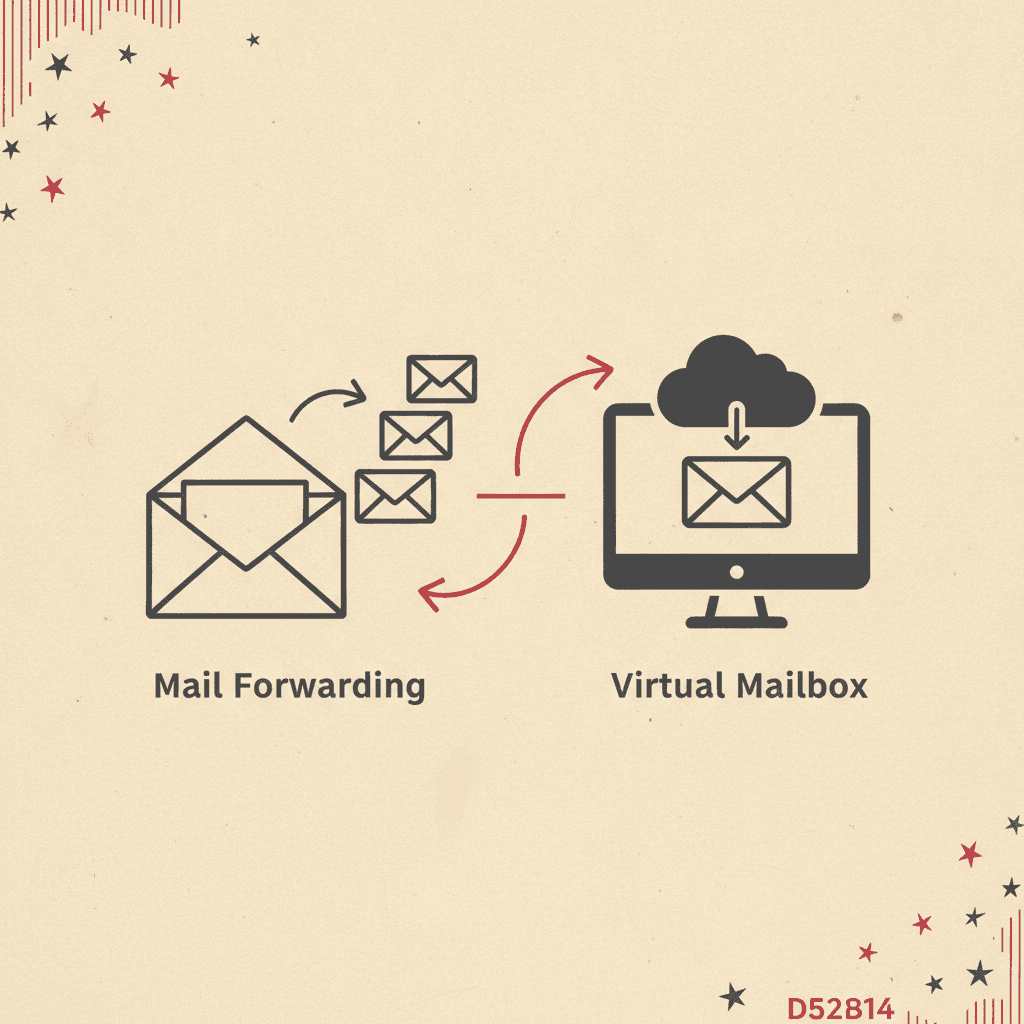
Most comparisons of these two treat them as rival products, as though you pick one the way you pick between two phone plans. They aren't rivals. One is a temporary redirect between two addresses you already have, and the other is an address.
Sorting that out matters because the failure mode is specific and common: someone uses forwarding as a stand-in for a permanent address, and then the forwarding period runs out while their bank, their state, and the IRS still have the old address on file.
What USPS forwarding actually is
Forwarding is what happens after you file a change-of-address order. The rules live in the Domestic Mail Manual (DMM), the postal rulebook that federal regulation incorporates by reference at 39 CFR 111.1.
There are two kinds of order, and they run on different clocks.
A permanent change of address creates a record that Post Offices keep for 18 months from the end of the month the change takes effect. But the record outliving the service is the part that trips people up. In the standards' own words: "Generally, forwarding is available for the first 12 months." The remaining six months of that record are used for address correction, which means notifying senders, rather than moving your mail.
You can buy more time. Extended Mail Forwarding can be purchased in six-month increments "for an additional 6, 12, or 18 months, or any combination, not to exceed 18 months." So the practical ceiling on a permanent order is 12 months free plus 18 months paid.
A temporary order works differently. It's for someone who is coming back, and it's capped: "not to exceed 12 months (364 total consecutive days)." The first order can run from two weeks to six months, and to reach the full year you file a second order beginning on day 186. Every temporary order has to specify both a beginning and an end date, so there's no version of this that quietly continues.
To file either one, you present PS Form 3575 at a Post Office with acceptable identification, or you use the online change-of-address application at moversguide.usps.com, which runs a device-reputation check and requires a credit card that gets charged an authentication fee. The in-person route carries no such fee.
Not all of your mail follows you
This is the part that surprises people who assume forwarding is a single switch. It's handled class by class.
First-Class Mail, Priority Mail, and USPS Ground Advantage are forwarded without charge when the sender has fully prepaid postage. Your bank statements, your state notices, and anything from the IRS travel in that lane, so the important mail does follow you.
Periodicals are forwarded free for 60 days. After that, the publisher gets an address-correction notice and the copies are disposed of by USPS. Your subscriptions stop long before your first-class mail does.
USPS Marketing Mail is the harsh one. Under the treatment table for undeliverable Marketing Mail, a piece bearing no endorsement is, in all cases, "disposed of by USPS." Whether an advertisement follows you is the sender's decision, made by which endorsement they printed on it, and it isn't yours. Marketing Mail is also "forwarded only to domestic addresses."
If you're moving abroad, that last point compounds into a wall. Four classes are barred from international forwarding in identical words: Periodicals, USPS Marketing Mail, Package Services and Parcel Select, and Priority Mail Express are each "forwarded only to domestic addresses." What can cross a border is narrow by comparison: First-Class and Priority Mail cards and unregistered letters, so long as they don't appear to contain merchandise and don't bear "Return Service Requested" or "Change Service Requested." A forwarding order is a much weaker instrument the further you get from a straightforward domestic move.
Premium Forwarding Service is a separate product
When people describe a service that boxes up their mail and ships it weekly, they usually mean Premium Forwarding Service (PFS) rather than ordinary forwarding. The standards are explicit that it's a different thing: "This optional service is separate from the forwarding service offered in 507.2.0."
PFS-Residential ships all mail from your primary address to a temporary address in a weekly Priority Mail shipment, dispatched on Wednesdays with tracking. It runs for a minimum of two weeks and a maximum of one year, and it costs a nonrefundable enrollment fee plus a weekly charge for every shipment. It's domestic only. You can't run it while a change-of-address order is active, and it isn't available if your primary delivery address belongs to a business or organization.
PFS-Commercial is the business-side version, for mail addressed to business PO Boxes or business street addresses, enrolled through the Business Customer Gateway with an annual fee and postage per shipment container. Registered Mail isn't eligible.
PFS-Local covers a narrower case: PO Box holders who want their box mail reshipped to their street address when both are served by the same facility.
One detail makes PFS more thorough than a plain forwarding order. Under PFS-Residential, "regardless of any mailer's ancillary service endorsement on a mailpiece," everything that fits goes into the weekly shipment. The marketing mail that a change-of-address order would have thrown away gets shipped.
The rule that settles this for most founders
Here is the sentence that almost no comparison article quotes, from DMM 507.2.2.7, the part of the forwarding standards headed "Mail Addressed to CMRA Customers":
"Mail addressed to an addressee at a commercial mail receiving agency (CMRA) is not forwarded through the USPS."
Commercial mail receiving agency is the regulatory category a virtual mailbox operator falls into, defined as a business that "accepts the delivery of U.S. Mail on behalf of another person or entity as a business service." Which means USPS forwarding and a virtual mailbox are not two ways of doing one job. USPS will not perform the redirect out of a mailbox address at all.
The standards then say how mail does leave: "The CMRA customer may make special arrangements for the CMRA operator to remail the mail with payment of new postage."
That explains something about pricing that otherwise looks like an upsell. Onward shipping shows up as a per-shipment charge rather than something a flat monthly fee absorbs, because the operator is putting new postage on the item and mailing it. There's no free postal redirect underneath it to fall back on.
Premium Forwarding points the same direction. PFS-Residential is unavailable to "customers whose primary address is a central point to which the USPS provides delivery in bulk to a third party, such as a commercial mail receiving agency," and PFS-Local carries that exclusion in the same words. So the ordinary forwarding order and two of the three Premium Forwarding variants all treat a mailbox service as a place where mail arrives rather than a place it routes onward from. The commercial variant's rules don't mention mailbox addresses either way, which is silence rather than permission.
There's a related rule worth knowing before you ever cancel one. The same section says a CMRA "must accept and remail mail to former customers for at least 6 months after termination of the agency relationship," and that after those six months "the CMRA may refuse mail addressed to a former customer." The CMRA chapter states the same window from the other side, that an agency "may not refuse delivery of mail if the mail is for an addressee who is a customer or former customer (within the past 6 months)." So closing a mailbox gives you a six-month floor to move your address of record, and not an indefinite grace period.
That floor is the default rather than a guarantee, and the exception is worth reading before you sign anything. The standards let you waive the remailing yourself in writing, and they say so explicitly: the obligation "need not be fulfilled if the CMRA customer provides written instructions to the CMRA that the mail (or specific types of mail) not be remailed upon termination of the relationship." Those instructions "may be provided in an internal service agreement between the customer and CMRA." In other words, the six months you're counting on can be signed away inside the terms of service you accepted on the way in. What a provider cannot do is have you instruct them to refuse mail or return it to sender, which the same paragraph rules out.
So which one is your situation
Forwarding assumes a fact about you that a lot of founders can't satisfy: that you have a second US address, one you control, where mail can pile up safely for the next year. If that address exists, forwarding is the cheaper and simpler tool, and you should use it.
The comparison only becomes live when that assumption fails.
- You're moving house inside the US. File a permanent change of address. You get 12 months to update everyone, and you can buy more. A virtual mailbox solves a problem you don't have.
- You're traveling for a few months and coming back. A temporary order or PFS-Residential fits, and both are built for exactly this shape of absence.
- You're leaving the country, or you never lived there. Forwarding has no good answer. It's domestic-first, it expires, and there's no US address on the receiving end to forward to. This is the case a mailbox address is for.
- You need an address that goes on filings. Forwarding can't help at all, because a redirect isn't an address you can write down. What you need is an address that stays put while you move, which is the whole proposition of a mailbox. Which slot each address goes in is its own question worth getting right.
Side by side
| USPS forwarding | Virtual mailbox | |
|---|---|---|
| What it is | A redirect from one address to another | An address of record |
| How long it lasts | 12 months, plus up to 18 purchased; temporary caps at 364 days | As long as the account is open |
| Needs a second address | Yes, that's the entire mechanism | No, it is the address |
| All classes of mail | No. Periodicals stop at 60 days, unendorsed Marketing Mail is discarded | Everything delivered to the box |
| You can read it remotely | No | Yes, mail is scanned |
| Onward shipping | Free for most first-class, within the period | Operator remails it, and you pay postage |
| Paperwork | PS Form 3575 | PS Form 1583 |
| Works from outside the US | Poorly | Yes, that's the design |
Frequently asked questions
Is a virtual mailbox the same as a virtual address? People use the phrases interchangeably, but only one of them is a regulated category. A virtual mailbox is operated by a commercial mail receiving agency under the postal standards, which is what makes it a real delivery point that can receive your mail. "Virtual address" gets used loosely for anything from that to a plan that only lets you print an address on a website.
Can I set up USPS forwarding out of my virtual mailbox? No. The standards say mail addressed to you at a CMRA is not forwarded through USPS. Your provider remails it instead, with new postage, which is why forwarding from a mailbox is priced per shipment.
How long does USPS forward mail? Generally 12 months on a permanent change of address, extendable by up to 18 more months for a fee. Temporary orders cap at 364 consecutive days.
What happens to mail sent to my old mailbox after I close the account? The agency has to accept and remail it to you for at least six months after the relationship ends. After that they're permitted to refuse it. Treat six months as the deadline for updating everyone who writes to you.
Does a PO Box work instead? For receiving personal mail, sometimes. As a business address on filings, usually not, and the reasons are specific enough that we covered them separately.
Bottom line
Ask which problem you have. If it's "my mail is going to the wrong place for a while," that's forwarding, and it's cheap and built for exactly that. If it's "I don't have a US address that stays still," no forwarding order fixes it, because forwarding is a bridge between two addresses and you're short one.
The postal standards make the split unusually clean. Mail arrives at a mailbox address, and USPS does not route it onward. Everything after that is your provider's job, and worth judging on how they do it: what they scan, how long they hold things, what they charge to ship an envelope, and what happens to the mail you never got around to dealing with. We graded the seven biggest providers on those questions and published the results by reader type.
We publish our own answers to those questions in full, including the limits, before anyone signs up. Our mailbox plans are in pre-launch, and ordering is free with nothing charged until launch.
If your mail question is on the Canadian side of the border, Canada Post runs different rules on different clocks, and we compared those separately.