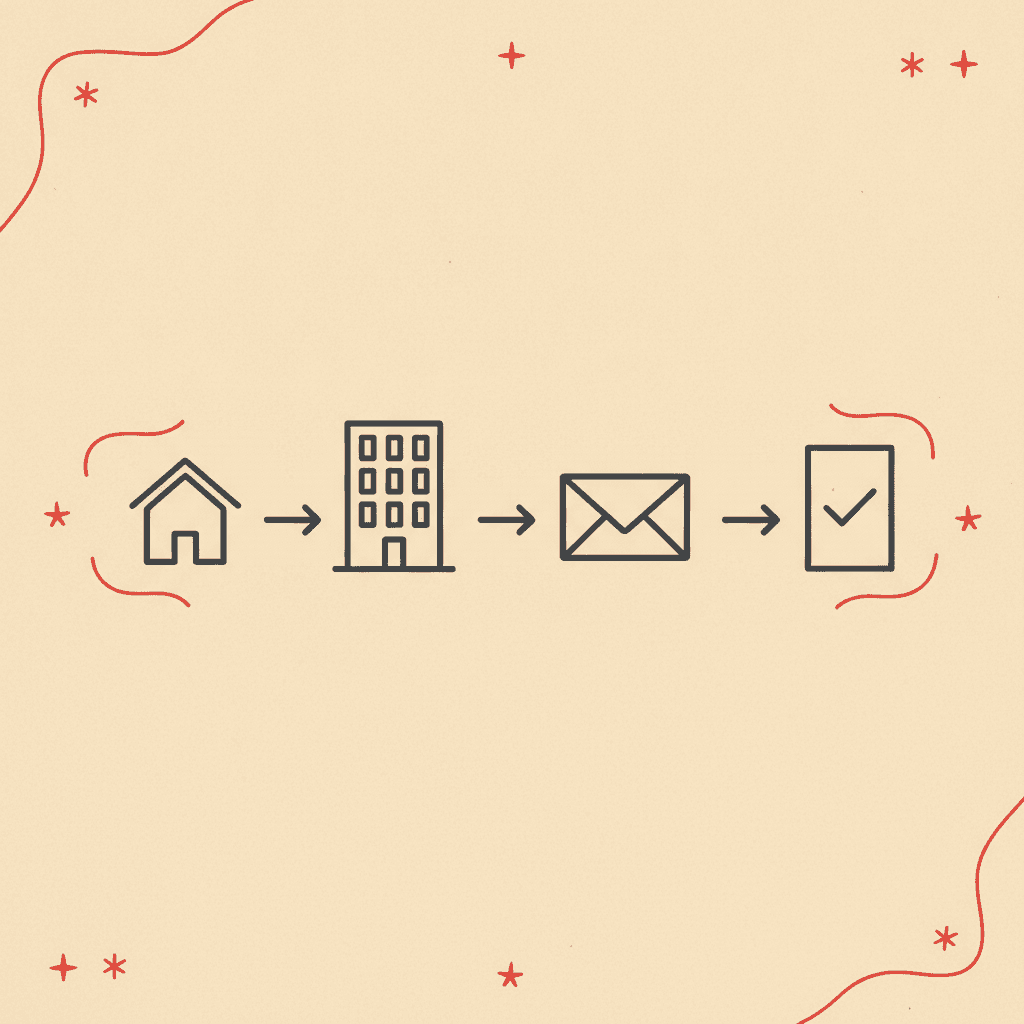
If you want somewhere to receive letters, you can use a virtual mailbox for personal mail. U.S. Postal Service (USPS) rules name private mailboxes used "for residential or personal use." The mailbox form still asks for your home address, so the box does not replace where you live.
We read five texts for this post. They are section 508 of the USPS Domestic Mail Manual (DMM), PS Form 1583 (June 2024), the federal bank identification rule, the REAL ID rule and IRS Form 8822. Below is what each one says about personal mail and about your home address.
Yes, the postal rules expect people to use a mailbox for personal mail
A virtual mailbox company is a commercial mail receiving agency (CMRA) under USPS rules. Your box there is a private mailbox (PMB). Our post on what a CMRA is explains the term in more detail.
DMM 508, section 1.8.3, covers delivery to a CMRA. Its first rule on the application form mentions personal use by name:
"A separate PS Form 1583 must be completed for each addressee of a Private Mail Box (PMB) for residential or personal use."
The next sentence in the same rule covers couples: "Spouses must each complete and sign a separate PS Form 1583 to both receive mail at the same PMB." In our reading, the manual treats a personal mailbox as a normal setup.
PS Form 1583 says the same thing on its first page. Item 3 is labeled "Type of Service Requested." The form gives two choices, "Business/Organization Use" and "Residential/Personal Use." The footnote attached to the personal box adds one condition:
"For Residential/Personal Use, complete a separate PS Form 1583 for each adult using this PMB."
So the form has a box built for people who only want personal mail. Business users fill in a different part of the form instead. The footnote for the business box says, "For Business/Organization Use, complete item 7."
What a virtual mailbox does for personal mail
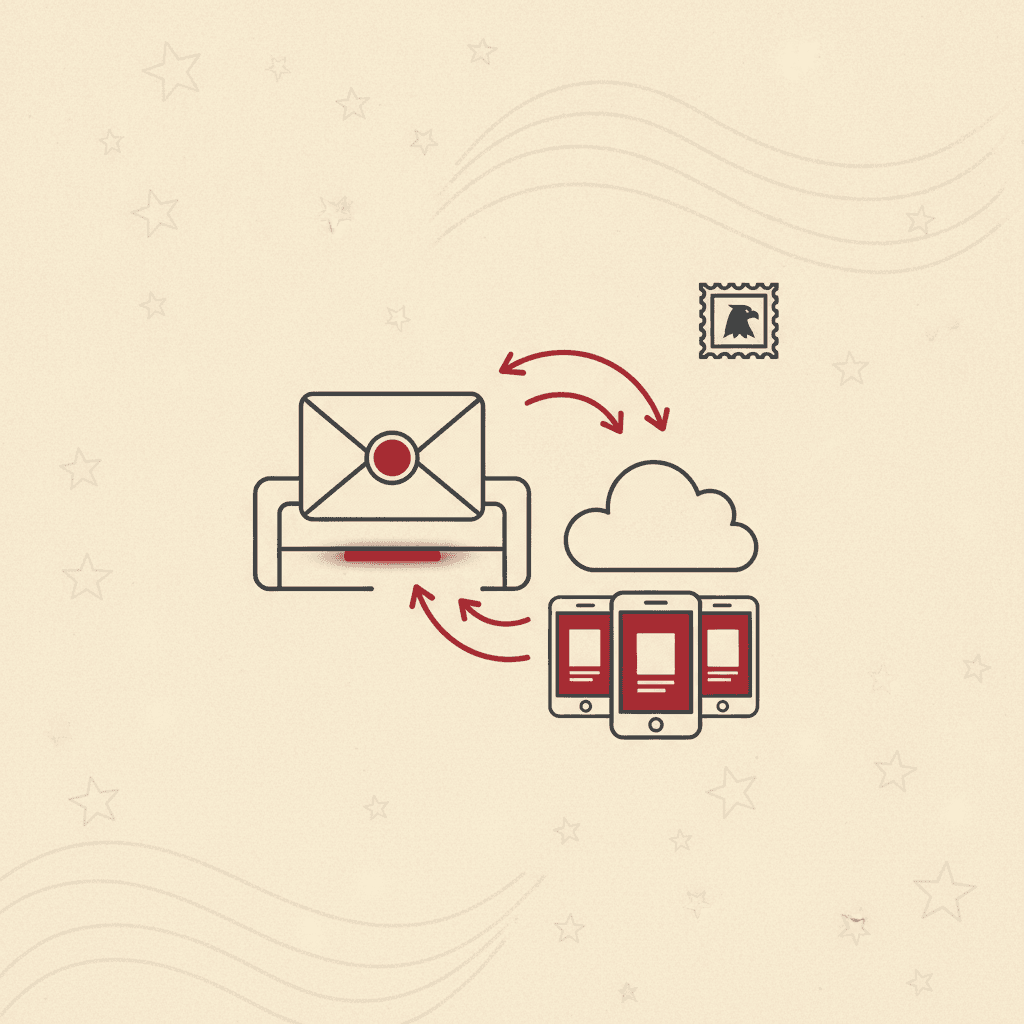
A virtual mailbox gives you a mailing address with a PMB number. Mail in your name goes to that address, and the provider receives the mail for you under your PS Form 1583. Each provider sets its own service on top of that, such as photos of envelopes, scans or package handling.
People choose a mailbox for personal mail for several reasons. Some are moving abroad and still get U.S. letters, which we cover in can I forward my US mail overseas. Some travel for long stretches. For a short trip, USPS Hold Mail is another choice, and we explain how long the Postal Service holds mail in how long does USPS hold mail.
Packages are their own topic. Our post on whether a virtual mailbox can receive packages covers package delivery. If you are comparing a mailbox with a box at the post office, read virtual mailbox vs P.O. box. A box at a shipping store is compared in UPS Store mailbox vs virtual mailbox.
What you sign as a personal user
The personal box on PS Form 1583 does not remove the home address questions. Item 4f is labeled "Applicant's Street Home Address." Footnote 4 adds, "Address must match document provided in item 9b."
We counted the word "home" on the June 2024 form, counting upper and lower case. The word appears 7 times. Four of those times, the word is part of a "Street Home Address" field. Two of those fields are for the applicant, and two are for an authorized individual named on the form. The other three times, the word sits in "Home or Vehicle Insurance Policy" twice and in a verification paragraph once.
The form also asks you to prove the home address. Item 9g reads "Address ID type (check one)" and says the document "Must Contain the Address in 9b-9f." The six choices on the form are these:
- "U.S. State/Territory/Tribal Driver's or Nondriver's ID Card"
- "Current Lease"
- "Mortgage or Deed of Trust"
- "Home or Vehicle Insurance Policy"
- "Vehicle Registration Card"
- "Voter Card"
In our reading, every choice on that list is tied to where you live or what you own. Footnote 9 sets the overall rule: "Two types of identification are required for both the Applicant and, if listed, the Authorized Individual. One ID must be a government-issued photo ID. The second must confirm the Applicant's or Authorized Individual's address listed on this form."
The mailbox company has to check those documents. DMM 508 says "The CMRA owner or manager must verify the documentation to confirm that the addressee resides or conducts business at the permanent address shown on PS Form 1583." The form adds that USPS itself may check:
"This application may be subject to verification procedures by the Postal Service to confirm that the applicant resides or conducts business at the home or business address listed in items 4f or 7c, and that the identifications listed in items 8–11 are valid."
False answers carry a cost. The DMM says, "Furnishing false information on the application … is reason for withholding the addressee's mail" and returning it to the sender. If your form comes back, our post on why PS Form 1583 gets rejected lists the common causes.
A mailing address is not always the address where you live
A virtual mailbox answers one question, which is where your mail should go. Many forms ask a second question, which is where you live. The texts we read ask that second question in different words.
| Form or rule | Where the text appears | What the address field asks for | Mentions private mailboxes or CMRAs? |
|---|---|---|---|
| PS Form 1583 | Item 4f | "Applicant's Street Home Address" | Yes, the form is for a PMB |
| Bank customer identification rule | 31 CFR 1020.220(a)(2)(i)(A)(3) | For an individual, "a residential or business street address" | No, 0 matches in the rule |
| REAL ID rule | 6 CFR 37.11(f) | Two documents showing your "principal residence," with a street address required | No, 0 matches in the section |
| IRS Form 8822 | Part I | Your "Home Mailing Address" | No, 0 matches in the form |
We searched each of the last three texts for "CMRA," "PMB," "private mail" and "virtual." Each search returned zero matches. So these texts neither allow nor forbid a mailbox address. Each agency or bank decides how its own field works.
Personal bank accounts
The federal rule tells a bank what to collect before it opens an account. Under item (3), the text reads "Address, which shall be: (i) For an individual, a residential or business street address;"
The same rule has a fallback for a person with no such address. The text reads "(ii) For an individual who does not have a residential or business street address, an Army Post Office (APO) or Fleet Post Office (FPO) box number, or the residential or business street address of next of kin or of another contact individual;"
The rule leaves the checking method to each bank. The text says "The CIP must include risk-based procedures for verifying the identity of each customer to the extent reasonable and practicable." CIP stands for customer identification program. In our reading, a bank's own policy decides whether a mailbox address fits its address field. Whether a mailbox address counts as residential or commercial is a separate question, covered in is a virtual mailbox address residential or commercial.
Driver's licenses and REAL ID
Section 37.11 of the federal REAL ID rule lists the documents an applicant must provide. Paragraph (f) covers the home address:
"To document the address of principal residence, a person must present at least two documents of the State's choice that include the individual's name and principal residence. A street address is required except as provided in § 37.17(f) of this part."
Section 37.17(f) lists the exceptions. One example is a person "enrolled in a State address confidentiality program." Each state picks the documents it accepts. We did not read any state's rules for this post, so check with your state's motor vehicle agency.
Your IRS address
Form 8822 is the IRS form for a change to your personal address. Part I is headed "Complete This Part To Change Your Home Mailing Address." The form's P.O. box rule reads, "Enter your box number instead of your street address only if your post office does not deliver mail to your street address."
The P.O. box sentence is about a USPS post office box. Form 8822 does not mention private mailboxes at all. The form does allow mail through another person: "If you receive your mail in care of a third party (such as an accountant or attorney), enter "C/O" followed by the third party's name and street address or P.O. box."
The form also explains why the IRS address matters. The notice on page 2 says "if you fail to provide the Internal Revenue Service with your current mailing address, you may not receive a notice of deficiency or a notice and demand for tax." Business addresses use another form, and Form 8822 says "Use Form 8822-B to change your business address."
The name on the envelope decides which plan you need
USPS rules tie each name at a PMB to a form on file. Our post on business mailing address vs business address explains how that rule sends back mail for names that are not on file. For personal mail, the result is simple to check. Look at the recipient lines on the envelopes you expect.
Our fair use policy states how our two plans split:
"Virtual Mailing Address accepts mail addressed to the individual names on your plan only, up to 2 names. If a business or trade name (an LLC, a corporation, or a DBA) appears anywhere in the recipient lines, even next to an individual name, the piece is business mail: we do not accept it, and it is returned to the sender. Business mail needs Virtual Business Address."
A household can share one personal box within those limits. Under USPS rules, each adult receiving personal mail at the box completes a separate PS Form 1583. Children are handled differently. Footnote 13 on the form says "For Residential/Individual Use: A parent or guardian may receive the mail of a minor by listing the minor's name" and then says "the minor's ID is not required."
This post explains the text of USPS rules, a USPS form, two federal regulations and an IRS form. The post is not legal or tax advice. Confirm how the rules apply to you with the agency or a professional.
How an Auteur address fits personal mail
We sell virtual mailboxes, so this is the seller's view. Auteur is in pre-launch, and your exact street address is assigned the day your city opens. We don't say a bank, a motor vehicle agency or the IRS will accept our address. Each one applies its own rules to its own address field.
Choose the Virtual Mailing Address if every envelope you expect carries an individual name. The plan takes up to 2 individual names. If any of your mail names an LLC, a corporation or a DBA (doing business as) name, the Virtual Business Address receives mail in a business or trade name as well.
Both plans photograph the envelope of every piece as it arrives, and we open and scan only when you ask, for one flat fee per piece. Henry, our AI assistant, explains each letter you ask us to open. Legal and tax mail is never destroyed automatically, and we contact you first every time. USPS Form 1583 is required before any provider can receive mail for you. Pricing comes by email with the next steps, and our fees and limits are in our fair use policy.
For mail in your own name, get your Virtual Mailing Address. Ordering is free, there's no card, and nothing is charged today. If a business name is on any envelope, the Virtual Business Address is the plan to choose.
FAQ
Can I use a virtual mailbox as my home address?
You can use a virtual mailbox as the address where your personal mail goes. PS Form 1583 still asks for your "Street Home Address" and an ID that confirms it. Forms that ask where you live, such as the REAL ID application, ask for your "principal residence."
Can I put a virtual mailbox address on my personal tax return?
Form 8822, the IRS form for changing a home address, asks for your "Home Mailing Address." The form allows a P.O. box only if your post office does not deliver to your street address. The form does not mention private mailboxes, so we can't say how the IRS treats one.
Will a bank open a personal account with a virtual mailbox address?
The federal rule asks an individual for "a residential or business street address" and leaves checking methods to each bank. The rule does not mention mailboxes. Ask the bank before you apply.
Can my spouse receive mail at the same virtual mailbox?
Yes, if each of you completes a form. DMM 508 says "Spouses must each complete and sign a separate PS Form 1583 to both receive mail at the same PMB." On our Virtual Mailing Address, the plan takes up to 2 individual names.
Bottom line
USPS rules expect people to use private mailboxes for personal mail. PS Form 1583 has a "Residential/Personal Use" box, and the DMM requires a form for each personal addressee. The same form asks for your street home address and an ID that proves it. Banks, state motor vehicle agencies and the IRS each ask their own address question, and the texts we read don't mention mailboxes. Use the mailbox for your mail, and answer each "where do you live" field on its own terms.