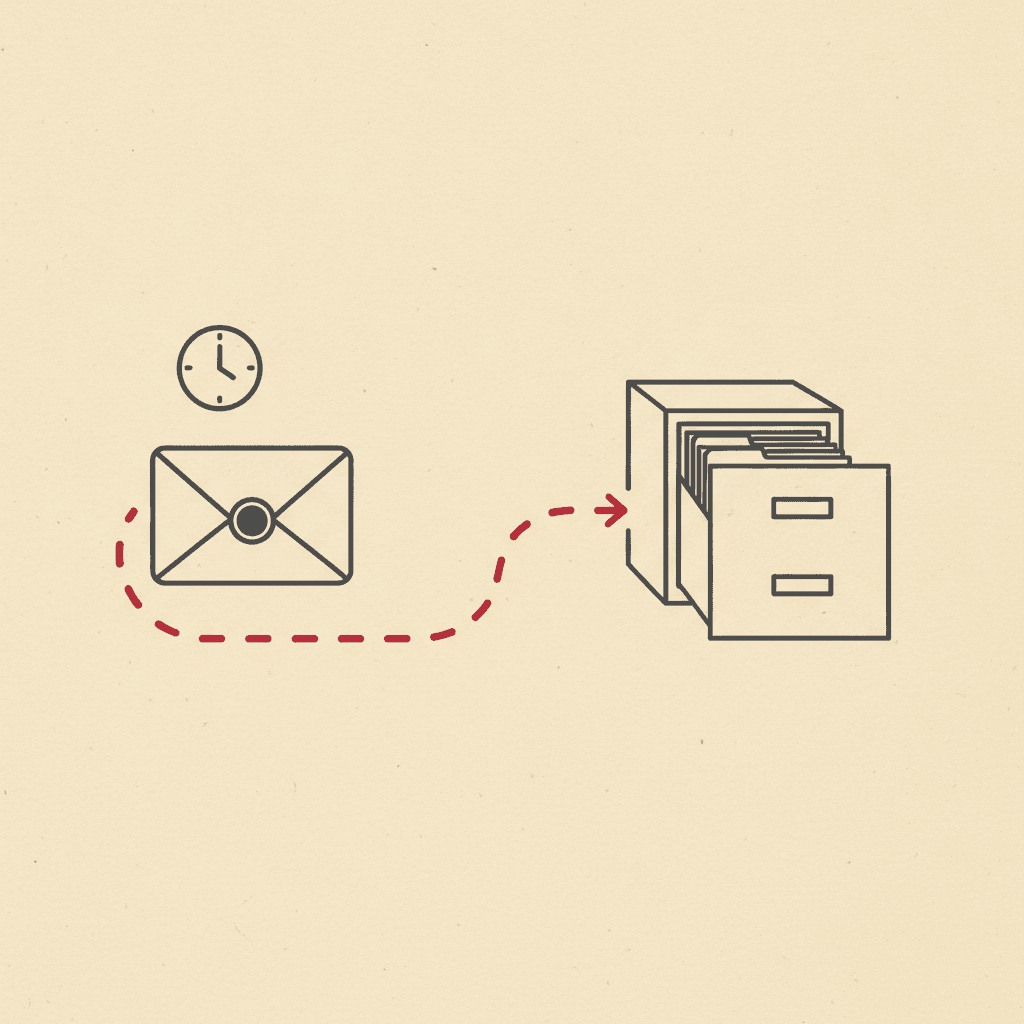
Most of what's written about this question says one sentence and stops: file Form 8822-B. The sentence is right. What it leaves out is everything that starts once the envelope is out of your hands, and that is where people actually get stuck. The form has no electronic path, so there's a delay with a published length. During that delay the IRS is still writing to the address it already holds. And whatever you write on the form becomes the address the agency uses on your filings for as long as you leave it there. So this article takes the three questions in order: which of the two similarly named forms your company files, what the form asks and which IRS address it goes to, and what reaches the old address in the weeks before the change takes effect.
The short answer is Form 8822-B, and it travels by mail
For a limited liability company with its own Employer Identification Number, the federal address change is Form 8822-B, Change of Address or Responsible Party, Business. The IRS describes the form as the way to "notify the Internal Revenue Service if you changed" your business mailing address, your business location, or the identity of your responsible party, and its About page draws the boundary on who it belongs to: the form "is for businesses and other entities with an Employer Identification Number application on file."
Three practical facts follow from that description, and none of them appear in the one-sentence version.
The first is the channel. You print the form, sign it, and mail it to the IRS service center the form routes you to. There's no upload and no confirmation screen.
The second is the clock. The instructions set the expectation in a sentence we quoted in full when we wrote about what happens after an EIN application is rejected: "Generally, it takes 4 to 6 weeks to process your address or responsible party change."
The third is the reach of what you're writing. A mailing address on an EIN record is not a delivery preference the agency keeps in a side file. It's the address the IRS uses for correspondence about the entity, and the SS-4 instructions say plainly that "Generally, this address will be used on all tax returns."
Put those together and the filing looks less like an errand and more like a decision. The errand takes ten minutes. The decision lasts years.
Can you change a business address with the IRS online?
This is the question people ask most, and the honest answer is the one nobody wants: no. That isn't a gap in our reading. The IRS publishes a list of ways to report an address change, and an online account is not among them.
Form 8822-B has no electronic filing channel. The form ends with a mailing address and a signature line, and the agency's own instructions for it point at an envelope. That isn't the oversight it looks like. The form moves a record attached to an EIN, and it requires a signature from a person with authority to act for the entity, which is the problem a web form would have to solve before the rest of it could exist.
The confusion usually comes from the individual side of the agency's online estate. It helps to look at what the IRS actually publishes. Its list of ways to report an address change names four methods: an IRS form, your next tax return, a signed written statement, and telling the agency in person or by telephone. An online account is not one of the four. The personal and the entity records are separate files with different keys as well, so anything filed under a Social Security number doesn't land on an EIN record.
The business-side account doesn't close the gap either. Business Tax Account is the IRS's online account for entities, and it's built around tax records and payments rather than around moving an address. It also carries an availability rule that removes it from the table entirely for a large share of the people asking this question. As the agency puts it, "Business Tax Account isn't yet available for LLCs that file as sole proprietors with Schedule C or Schedule F (Form 1040)." A default single-member LLC has no account there to log into, which we went through in detail when covering how to get an EIN verification letter.
Three of those four aren't the form, and the return is the one worth understanding first. The address on your most recently filed and properly processed federal return is the address the IRS treats as yours unless it receives clear and concise notification of a different one, which is the rule we set out in our piece on using a registered agent address as your business address. Filing a return with the new address on it is a real way to move the record. The catch is that a return arrives once a year and then has to be processed. If notices are going to the wrong place right now, the return isn't a fix. It's a backstop.
The written statement and the spoken notification are the agency's own channels rather than workarounds, and both list the EIN among the identifiers they accept, so neither is closed to a company. What tips the choice toward the form is evidence. A signed 8822-B leaves you holding a dated copy of what you told the IRS and when, which is the thing you want in hand if a notice turns up later at an address you thought you had changed.
The practical answer, then, is to mail the form, and to put the new address on the next return you file anyway. Doing both isn't a conflict. It's one address arriving through two doors.
Form 8822 or Form 8822-B: the EIN decides which one you file
The two forms have almost the same name, and the difference between them isn't the one people assume.
Form 8822 is titled Change of Address, and it moves the home mailing address the IRS holds for an individual. Form 8822-B adds a suffix and a scope, and it moves the record attached to an EIN. The instructions handle the overlap case in a note aimed at exactly the person reading this: "Changing both home and business addresses? Use Form 8822 to change your home address."
Where founders go wrong is in reasoning from tax classification instead of from records. A single-member LLC is a disregarded entity by default, so its income lands on the owner's individual return, and the conclusion looks obvious: if the IRS ignores the company for income tax, the company's address must be the owner's address. That isn't how it works. Disregarded describes how income is reported, and it doesn't erase the EIN record, which the agency opened when the company applied and which keeps its own name, its own responsible party and its own address. What the word does and doesn't cover is the subject of our disregarded entity guide.
So the test is simpler than the tax question. Ask which record has the stale address in it.
| Form 8822 | Form 8822-B | |
|---|---|---|
| Full title | Change of Address | Change of Address or Responsible Party, Business |
| What record it moves | The home mailing address the IRS holds for you as an individual | The mailing address, business location and responsible party on an entity's EIN record |
| Who the IRS says it's for | An individual taxpayer changing a home address | Entities "with an Employer Identification Number application on file" |
| Single-member LLC with its own EIN | For the owner's home address, if that moved too | For the company's address on the EIN record |
| Single-member LLC with no EIN of its own | This is the filing that matters, since there's no entity record to move | Not applicable, since the form belongs to EIN holders |
| Multi-member LLC, corporation or partnership | Only for an individual's own home address | The entity filing |
| How it's submitted | By mail | By mail |
The row that catches the most people is the fourth one. A founder who works out of the apartment listed on the company's formation papers has two records with the same address written in them, and moving house breaks both. One form fixes one of them. Sending only 8822-B leaves your personal correspondence going to the old apartment, and sending only 8822 leaves every notice tied to the EIN going there.
One field on Form 8822-B is a different kind of change with a different deadline attached. Reporting a new responsible party isn't the same as reporting a move, and the IRS gives that change its own reporting window. Who qualifies as the responsible party, and how long you have to report a change, are covered in our EIN responsible party guide.
What the form asks, and which IRS address the envelope goes to
The form is short, and three parts of it decide whether it does what you wanted.
It asks what the change covers
The top of the form asks you to check what the change affects, so the agency knows which records to move rather than guessing. Business returns have a box, employee plan returns have their own, and business location has a third, which means the last box isn't about a filing at all. Slow down here if the company has more than one kind of federal obligation, because a change applied to one account and not another produces the worst version of this problem: mail arriving correctly from one part of the IRS and incorrectly from another, with nothing on either envelope to explain the split.
The mailing address and the business location are separate lines
The form keeps the same split that Form SS-4 uses, and for the same reason. Your mailing address is a delivery question. Your business location is a claim about where the company physically sits. The SS-4 instructions define the first one with the instruction to "Enter the mailing address for the entity's correspondence," and puts a flat restriction on the second: "Don't enter a P.O. box number here."
Two consequences follow. If your new arrangement is a box at a post office, it can serve as a mailing address and it can't fill the location line, which is the mechanic we worked through in Can a PO Box Be Your Business Address?. And if the two addresses are genuinely different for your company, they need to stay different on the form, because collapsing them tells the IRS something about your physical presence that you didn't mean to say. The distinction in full is in business mailing address vs business address, the line-by-line walkthrough of the SS-4 fields is in our business mailing address guide, and what the location line is actually asking about is in our principal place of business guide.
Somebody with authority has to sign it
The form is signed by a person who can sign for the entity, and the signature block names the roles it will accept. For a single-member LLC that person is the owner. This requirement is the quiet reason the whole filing lives on paper, and it's also why a formation service can't push the change through without involving you.
Then there's the envelope itself, and the routing has a detail that gets copied wrong constantly.
| What you're changing | Where it goes on the form | What it moves |
|---|---|---|
| Business mailing address | The old address line, then the new address line | Where IRS correspondence about the EIN is sent |
| Business location | Its own line, separate from the mailing address | The physical address the IRS holds for the entity |
| Responsible party | The name line plus the identifying number line | Who the IRS treats as controlling the entity, on its own deadline (guide) |
| What the change affects | The check boxes at the top | Business returns, employee plan returns and business location each get their own box |
The form's Where To File section is a short table, and the row you use is chosen by the state your old business address was in. One row sends the form to an IRS service center in Kansas City, Missouri. The other sends it to Ogden, Utah. The state lists and the exact ZIP codes are printed on the form, so read them there rather than reusing an IRS address off a return or out of an article. The routing follows the address you're leaving behind rather than the one you're moving to, which is counterintuitive enough to check twice before the envelope is sealed.
What reaches the old address while the change is in process
Here is the part the one-sentence answer skips entirely, and it's the part with money in it.
The instructions say the change generally takes four to six weeks to process. Until it is processed, nothing about your federal mail has changed. The IRS is not holding your correspondence while it updates a file. It's sending that correspondence, on its own schedule, to the address it currently has.
That has a specific consequence for anything you request during the window. When the IRS mails an EIN verification letter, its manual tells staff to send it "to the address of record," meaning the address in its system on the day the request is worked rather than the address in the envelope you mailed last week. A founder who changes an address and immediately requests a letter can end up with the letter going exactly where they were trying to stop mail from going. A company that does have a Business Tax Account can view an EIN verification letter inside it and skip the envelope altogether, but that route is closed to the Schedule C filers who ask this question most. The order that avoids the problem, and the rest of the mechanics of that request, are in our piece on Letter 147C.
The same window applies to mail you didn't ask for, and that's the half with a deadline on it. Federal notices carry response periods that start running from the date they're mailed, and the agency's obligation is measured by the mailing rather than by whether you read it, a rule we set out at length in the registered agent address piece. A notice correctly mailed to your address of record during the processing window is a valid notice. "It went to my old apartment" isn't an argument the system recognizes.
Three things reduce the exposure, and they're all small.
Keep the old address collecting for the length of the window if you still control it. Six weeks of forwarding, or of a neighbor who'll text you a photo, is cheap insurance against a notice you'd otherwise hear about from a second letter. There's a second reason too: when the IRS does confirm an employment tax address change, it sends CP148B to the address you're leaving, so the letter telling you the move went through can be one of the things waiting at the old door.
File once. Each change starts its own four to six week window, so an address you're going to revise again in four months costs you a second one, and the second window is when the notices you care about tend to arrive.
Tell the state separately. Your federal record and your state record are two files at two governments, and neither one updates the other. In most states the yearly filing you already owe is the document that resets what the state holds, which is the point we made in what an LLC files every year. If you're moving, the two filings belong in the same week.
The address you write on the form is the one you'll be living with
Now the question worth actually spending time on. The form takes ten minutes. Choosing what goes on it is the part that decides whether you do this again next year.
Look again at what the SS-4 instructions say about this field: "Generally, this address will be used on all tax returns." What you're about to write is not just where a confirmation letter lands. It's the address the IRS carries forward, prints on notices, and treats as yours until you file this form a second time. So the test isn't whether the address is correct today. It's whether mail sent there will still reach you in three years.
Measured that way, most of the obvious candidates fail. A rented apartment fails when the lease ends. A co-working desk fails when you cancel the membership, and it fails faster than the lease does. A family member's house holds up right until the year nobody thinks to mention that a government envelope arrived, and the reasons a home address on a business record causes trouble beyond delivery are in Can I Use My Home Address as My Business Address?.
What the line actually needs is narrower than it looks. It has to accept mail in the LLC's name, and it has to stay put when you move.
That's what Auteur's Virtual Business Address is built for. You can order one today at the founding price, with nothing charged: a commercial street address in a US city, built to receive mail addressed to your business or trade name, with one business or trade name plus up to six individual recipient names on the account, from $14.99 a month, envelope photos included, and opening and scanning a piece at $1.99, only when you ask. It will be the address on the EIN record that survives your next move, once your city opens. Our Virtual Mailing Address plan is the wrong product for this page, and we'd rather say so than sell it: mail addressed to a business or trade name cannot be accepted on that plan, so an LLC's federal correspondence needs the business address.
Two boundaries belong in the same paragraph. This is a mail service. It is not a registered agent service, and it does not register your business with the state, so it doesn't fill the agent slot on your state filing, which we covered in Can a Virtual Mailbox Be Your Registered Agent?. And a mail address answers the mailing question rather than the location question, so if the IRS or a bank is asking where the company physically operates, that's a different field with a different rule, mapped in which of your LLC addresses are public record. If the mailing line is the one you're solving, you can get your address in about a minute. Nothing is charged there, and we email you the next steps.
If the entity isn't an LLC
The head of this question is an LLC because that's who asks it most, and the form is the same instrument for most of the entities around it. What changes is which record exists in the first place.
| Your situation | The federal filing | The thing to watch |
|---|---|---|
| Corporation with an EIN | Form 8822-B | The signature has to come from someone with authority for the corporation |
| Partnership or multi-member LLC | Form 8822-B | The mailing address and the business location are separate lines, and partnerships often have genuinely different answers for each |
| Sole proprietor with an EIN | Form 8822-B for the EIN record, and Form 8822 for the home address | Two records, two forms, and a sole proprietor working from home usually has both to move |
| Sole proprietor with no EIN | Form 8822 | There's no entity record to change, so the personal filing is the whole job |
| Tax-exempt organization | Form 8822-B, and the annual return in the Form 990 series also carries addresses | An exempt organization's address is public in a way a private company's isn't, which raises the stakes on the choice |
Two of those rows deserve a sentence more.
The sole proprietor rows are the ones most often answered wrong on the open internet, because an unincorporated business without employees usually has no EIN, and advice written for companies doesn't apply to it. If your business files under your Social Security number, there's no separate business record at the IRS, and Form 8822 does the whole job.
The exempt organization row runs in the opposite direction. A nonprofit that files a Form 990 series return is putting its address into a document that gets published, so the address decision carries a disclosure question on top of the delivery one. Something similar happens to a for-profit company at the state level, where the address you file goes onto a searchable record.
FAQ
Can I change my business address with the IRS online?
Not through Form 8822-B, which has no electronic submission channel. The IRS list of ways to report an address change names four methods, and an online account isn't one of them. Business Tax Account, the business-side account, is built around tax records rather than address changes, and the IRS says it "isn't yet available for LLCs that file as sole proprietors with Schedule C or Schedule F (Form 1040)," a limit we went through in how to get an EIN verification letter. The realistic route is a signed form in an envelope, plus the new address on your next return.
How do I change my LLC address with the IRS?
File Form 8822-B, Change of Address or Responsible Party, Business. Check which of the entity's filings the change applies to, enter the old mailing address and the new one, use the separate line if your physical business location is also changing, and have someone with authority for the LLC sign it. Then mail it to the service center the form's Where To File table assigns you, which is chosen by the state your old business address was in. Keep a copy with the date you mailed it.
Do I use Form 8822 or Form 8822-B for a single-member LLC?
It depends on which record moved rather than on how the LLC is taxed. If the LLC has its own EIN, the company's address sits on that EIN record and Form 8822-B moves it, even though the LLC is a disregarded entity for income tax. If you also moved house, Form 8822 moves your personal address, and the 8822-B instructions say so directly: "Changing both home and business addresses? Use Form 8822 to change your home address." If the LLC never obtained an EIN and you file under your Social Security number, Form 8822 is the only filing involved.
How long does it take the IRS to update a business address?
The instructions give one number: "Generally, it takes 4 to 6 weeks to process your address or responsible party change," which we quoted in full in what an EIN reference number 101 means. There's no tracking number to follow it with. Whether written confirmation arrives depends on what the company files: the IRS says that for address changes relating to an employment tax return it issues confirmation notices, CP148A to the new address and CP148B to the former one, and its CP148A page names Form 8822-B itself as one of the things that trigger them. A company with no employment tax filings may see nothing come back. Either way the change isn't retroactive, so anything the IRS mails during those weeks goes to the address it still has on file, which is why requesting documents right after sending the form tends to backfire.
What happens if I don't tell the IRS my LLC moved?
The IRS keeps writing to the address it has, and its obligation is generally satisfied by the mailing rather than by your receipt. Response windows on notices run whether or not the envelope reached you, and the first sign of a problem is often a second letter about the first one. The form's own Privacy Act notice is direct about the penalty question: "You will not be subject to penalties for failure to file this form." The sentences after it are the ones worth reading twice, because they say what happens instead. If the IRS doesn't have your current mailing address, you "may not receive a notice of deficiency or a notice of demand for tax," and "penalties and interest will continue to accrue on any tax deficiencies" regardless. The cost shows up as missed deadlines on notices you never saw.
Do I have to tell the state as well as the IRS?
Yes, and they're separate filings that don't talk to each other. The IRS holds the EIN record. Your formation state holds the registered agent, the principal office and the mailing lines on its own record, and in the states we've read, the periodic report you already owe is the filing that resets them. The mechanics of that are in LLC annual compliance requirements. If your company is on file in more than one state, each one wants its own update.
Bottom line
The filing is Form 8822-B, it goes in the mail, and the instructions put it at four to six weeks. Everything difficult about this question sits inside that sentence rather than after it. There's no online channel to hunt for, so the hunting is time spent. The form you send turns on whether an EIN record exists rather than on how the LLC is taxed, and a founder who moved house and moved the company has two forms to write. And because the IRS keeps using the old address until the change clears, the weeks after you mail it are exactly the weeks a notice is most likely to land somewhere you can't reach.
So spend the time on the address instead of the form. The mailing address on an EIN record is the one the agency prints on your filings until you change it again, and the version of this task nobody enjoys is the one where you do it twice. If you want an address that will still be receiving your company's mail after the next move, you can get your address now, so the next time you file this form is the last time.
This is general information about federal filing procedures rather than legal or tax advice. IRS forms, instructions and processing times are revised over time, so confirm the current version of Form 8822-B and its Where To File table on irs.gov, or check with a qualified professional about your situation.