Key takeaways
- On June 27, 2026, the federal government pre-published its proposed Consumer-Driven Banking Regulations in the Canada Gazette, Part I, opening a 60-day comment window. It's the operational next step for Canada's open banking system — not a switch flipped overnight.
- For a newcomer to Canada with no credit history, the point that matters is the mechanism underneath: open banking is built to let a lender read your actual bank transaction data, with your consent, instead of relying only on a thin or empty credit bureau file.
- That's a real change for founders who are "credit invisible" — reportedly a far more common situation for newcomers than for the general population — because it turns real Canadian cash flow into evidence a lender can read before a bureau file has had time to build.
- What to do now is unglamorous but decisive: route your business income and payments through a clean Canadian account, keep the transaction record legible, and keep one consistent Canadian address across the account, the entity, and the CRA — so the data is worth reading when the rules go live.
What changed: Canada's open banking rules moved a step closer
The short version, if you're a newcomer founder searching this: on June 27, 2026, the federal government pre-published its proposed Consumer-Driven Banking Regulations in the Canada Gazette, Part I, and opened a 60-day public comment period. It's a milestone in standing up the framework Canadians usually call open banking — officially, consumer-driven banking — and the Department of Finance has framed the first phase around secure, consent-based "read access" to your own financial data.
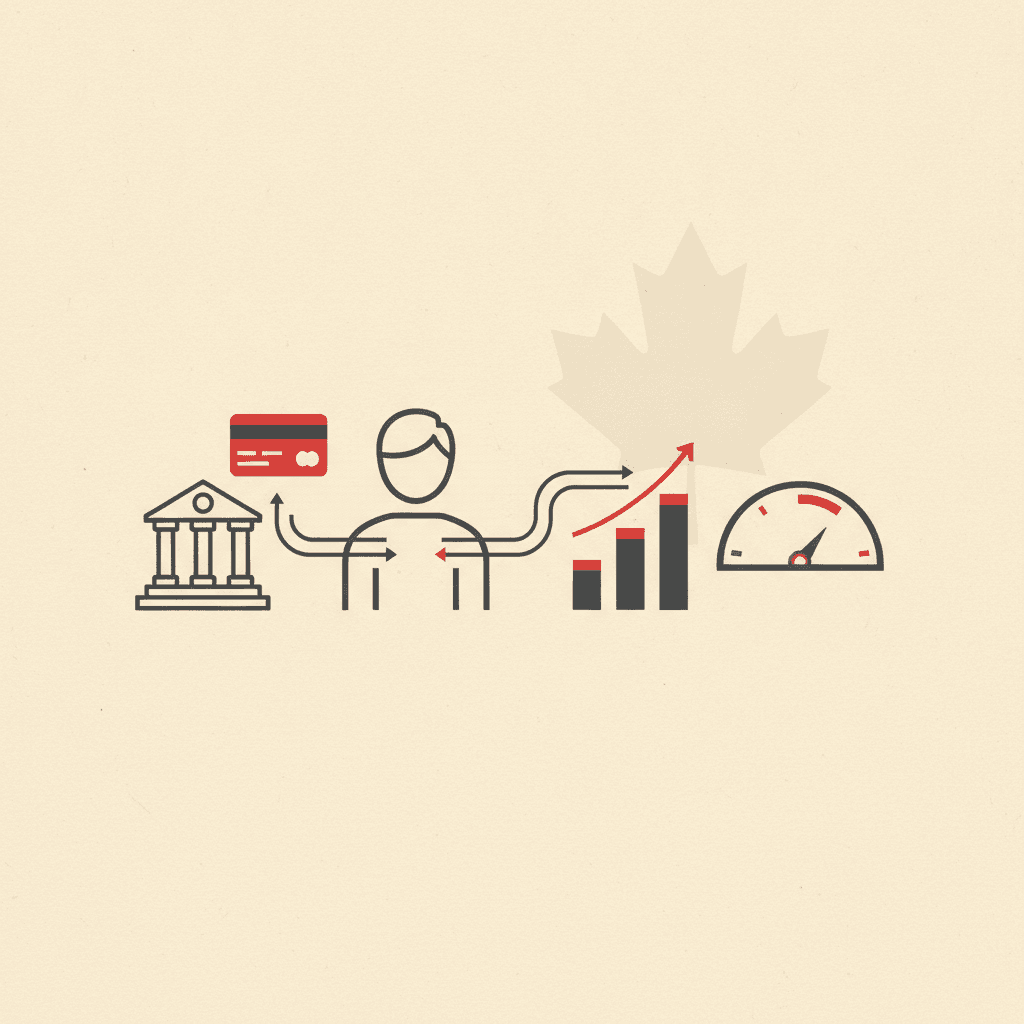
Why this specific event matters to someone with no Canadian credit history: the whole point of consumer-driven banking is that you can authorize a lender or an accredited provider to read your bank transaction data directly — your income deposits, your rent and utility payments, your day-to-day cash flow — rather than judging you only on a credit bureau report. Today, a thin file means a lender has almost nothing to read, so the standard application stalls. Open banking is designed to give them something else to read: the real record of how money actually moves through your account.
One honest caveat up front. The June 27 pre-publication is a comment stage, with feedback open for roughly 60 days (to late August 2026), not a live consumer product you can use tomorrow. The direction is set and the plumbing is being built; the practical takeaway is to position for it now, not to wait for it before doing anything. This is general information for newcomer founders, not financial or legal advice.
Who this affects: the "credit invisible" newcomer founder
This lands hardest on one group: people building a business in Canada who arrived with no Canadian credit history at all. If your file at Equifax Canada or TransUnion Canada is blank or barely started, you already know the pattern — the business account opens on documentary identity, but the business credit card, the net-30 supplier terms, the equipment financing, and the line of credit all want a file you don't have yet.
Newcomers are widely reported to be far more likely to be "credit invisible" than the general population — by some estimates roughly twice as likely. Treat that as direction, not a precise figure; the underlying reality is the part that's solid: foreign credit history doesn't transfer to the Canadian bureaus, so a founder who managed a decade of clean credit abroad can still read as a blank to a Canadian lender on day one.
Consumer-driven banking is aimed squarely at that gap. When a lender can read your actual repayment behaviour and cash flow with your permission, a founder with six months of steady Canadian deposits and on-time outflows stops being invisible — the account itself becomes the evidence. Note the boundary of this brief: it's about the finance and credit layer only. Whether your status permits you to own or run a business is a separate question this article doesn't touch.
What it means for you — and what to do now
Here's the practical read. Open banking doesn't hand you a credit score. It changes what a lender is allowed to look at — which means the founders who benefit most are the ones whose transaction record is already clean and readable when the rules go live. The work to do now is to build that record.
1. Route real business activity through one Canadian account early
The data open banking shares is only as useful as the account behind it. An account with three months of steady income deposits, paid suppliers, and on-time transfers tells a cash-flow story; an account that money passes through erratically does not. So the first move is to get a Canadian business account open and actually running — see how to open a Canadian business bank account as a non-resident or foreign founder for the documentary path. The sooner it's the hub for your income and expenses, the sooner there's a track record worth reading.
2. Keep the cash flow legible
Cash-flow-based assessment rewards patterns a human — or a model — can read at a glance: regular deposits, low or no overdrafts, on-time recurring payments, expenses that look like a business. Paying your rent, utilities, and key suppliers from a consistent account means those on-time payment patterns show up in the transaction data, even though rent and utilities famously do not land on your bureau file by default. Under open banking, that previously invisible history can finally count for something — but only if it's flowing through the account you'll later authorize a lender to read.
3. Don't drop the conventional credit file — this is additive
Open banking supplements the bureau file; it doesn't replace it. A first secured or newcomer card, used cleanly, still builds the Equifax Canada and TransUnion Canada history that many products will keep asking for. The full general playbook — the Big Five newcomer programs, the secured-card fallback, the six-to-twenty-four-month timeline — is its own topic, and we cover it end to end in building a Canadian newcomer credit history. Run that track in parallel. The goal is to arrive at the moment cash-flow lending products go mainstream with both a clean transaction record and a started bureau file.
4. Keep one address across every record
This is the quiet one that breaks things. When a lender reads your bank data and cross-checks it against your business registration and your CRA file, the addresses have to match. A home address on the registry, a different address at the bank, a PO Box somewhere else — that mismatch is exactly what gets an application flagged, and no amount of clean cash flow fixes a record that doesn't reconcile. One consistent Canadian business address across all of it is the cheapest insurance you can buy against that.
5. Watch for accredited cash-flow products — and consent deliberately
As the framework operationalizes, expect lenders and accredited providers to offer products that assess you on cash flow instead of file thickness. When they do, you'll be consenting to share sensitive financial data — so treat each authorization the way you'd treat any KYC step: know who's accredited, share the minimum needed, and keep a record of what you granted. Consent-based read access is the entire design; using it well is on you.
The address and setup angle: where this plugs into your founder sequence
Step back and the newcomer founder setup runs in a fixed order: a Canadian business address (Toronto or Vancouver) → a CRA Business Number and entity → a business bank account → business credit. Open banking changes what the last step depends on. Instead of waiting one to two years for a bureau file to thicken, the transaction data flowing through step three becomes credit evidence in its own right — which raises the stakes on getting steps one through three set up cleanly and early.
That first fixed step is the address, because everything downstream inherits it. Your Business Number is written onto whatever address you register, your bank account's KYC file checks against that same address, and any lender reading your data later cross-references all three. For a newcomer the default options both fail here: a friend's or relative's home address puts their address on the public registry and re-files everything if they move, and a PO Box gets rejected because it isn't a real street address. What passes is a commercial Canadian street address in proper Canada Post unit format, documented in your name.
That's the layer Auteur exists to cover — a real Toronto or Vancouver business address with staffed Canadian reception and self-certified identity handling (Canada has no Form 1583 or CMRA regime), set up entirely online so it's in place before you register. Reserve a Toronto or Vancouver address and the same address sits on your registration, your CRA file, and your bank account from day one — so when a lender reads your data, everything reconciles.
FAQ
Does open banking let you build business credit in Canada with no credit history? It's designed to help. Consumer-driven banking lets you authorize a lender or accredited provider to read your actual bank transaction data — income, payments, cash flow — rather than judging you only on a credit bureau file. For a founder with a thin or empty file, that means a clean record of real Canadian activity can serve as evidence a lender reads, instead of an automatic decline. It doesn't replace a credit score, and it isn't a live consumer product yet as of mid-2026 — but it changes what a lender is allowed to look at, which is the barrier that stalls credit-invisible newcomers first.
Is open banking live in Canada yet? Not as a consumer product you can use today. The June 27, 2026 milestone was the government pre-publishing its proposed Consumer-Driven Banking Regulations in the Canada Gazette, Part I, with a roughly 60-day public comment period. That's an operational step in building the first "read access" phase, not a launch. Confirm the current status on the Department of Finance pages before you rely on any specific timeline.
How do I build a credit score in Canada as a newcomer in the meantime? The conventional path still applies and you should run it in parallel: open a chequing account through a newcomer program, get a first secured or unsecured card, use it cleanly, and let the on-time history report to Equifax Canada and TransUnion Canada over roughly six to twenty-four months. We walk through the full sequence — the Big Five programs, the secured-card fallback, and the address that has to stay consistent — in building a Canadian newcomer credit history.
Bottom line
Canada's open banking rules took a real step forward on June 27, 2026, when the government pre-published its proposed Consumer-Driven Banking Regulations and opened them for comment. For a newcomer founder with no credit history, the change worth understanding isn't the paperwork — it's the mechanism: a system built to let lenders read your actual cash flow with your consent, so a clean Canadian transaction record can stand in for a bureau file you haven't had time to build. It isn't live yet, so the move now is to position for it: run real business activity through one Canadian account, keep the cash flow legible, keep building the conventional file in parallel, and keep one consistent address across every record. Get the foundation right and you'll arrive at cash-flow lending ready to be read. Reserve a Toronto or Vancouver address and start that record on one stable address from day one.
This brief is general information for newcomer founders — not financial, legal, or tax advice. Consumer-driven banking rules are still in the comment and rollout stage; confirm the current status and any product terms with the relevant provider and with the Department of Finance Canada before you rely on them.
Sources: Canada Gazette, Part I — proposed Consumer-Driven Banking Regulations (June 27, 2026); Department of Finance Canada — news (June 2026). The credit-invisibility comparison is directional, drawn from widely reported industry estimates, not a precise government statistic.