Key takeaways
- The "team of one" is now a mainstream company shape. Through the first half of 2026, the one-person company running on software became a defining story — with roughly 74% of solopreneurs reporting they've scaled without hiring, and single-founder startups now over a third of new launches.
- AI covers the production of a business — not its existence. It drafts, answers, researches, and reconciles. It cannot make a bank, a government registry, or a payment platform believe your business is real.
- Three gaps refuse to close on their own: a real business address institutions accept, registering or incorporating the entity, and a business bank account with the identity check behind it.
- All three share one root: a verifiable business address in a real city, tied to your identity. That's the layer AI leaves for you — and the one worth setting up deliberately.
What's happening: the "team of one" goes mainstream
Through the first half of 2026, one storyline kept repeating in the North American business press: the solo founder running a real company alone, with software doing the jobs a small team used to hold.
The numbers behind it are self-reported survey data, so read them as direction rather than precision:
- Around 74% of solopreneurs say they've scaled without hiring, and 91% say AI has reduced their administrative work (Zoom + Upwork Small Business AI Report, reported by Forbes, May 2026). Founders describe AI absorbing hours of routine work a day — though those time savings are self-reported and qualitative, not a hard benchmark.
- The US alone is home to roughly 41 million solopreneurs and nearly 30 million non-employer businesses — the one-person operation is now mainstream, not a fringe (Fortune, May 2026).
- The share of new startups launched by a single person rose from about 23.7% in 2019 to around 36.3% by mid-2025 (Carta Solo Founders Report, 2025), while LinkedIn profiles carrying a "founder" title grew roughly 69% year over year (LinkedIn News).
A steady wave of new frontier models and agent tools from Google, Anthropic, and others through mid-2026 kept widening what one person can plausibly do without hiring anyone — Anthropic's cheaper Claude Sonnet 5 and its Claude for Small Business push are a good example, and land on the same conclusion this piece does about the one business job that stays out of reach.
None of that is the interesting part, though. The interesting part is what all of this automation still does not touch — and why that matters more the leaner you run.
Who this affects
If you are building alone in the US or Canada, this is your operating reality now, not a forecast:
- Solopreneurs and indie founders running a product or an agency with no employees.
- Freelancers and consultants who have quietly turned into a business.
- Creators converting an audience into a company — courses, memberships, merch, sponsorships.
- Newcomers to Canada or the US launching a first business while still building local credit and history.
There's a cross-border wrinkle that hits one-person companies harder than most. These businesses are often location-flexible by design. A founder living in Canada might sell into the US or hold a US LLC; a founder in the US might incorporate in Canada to reach Canadian customers. AI ignores borders entirely. The address, registration, and banking layer does not — and that's precisely where the gap opens up.
What AI already handles for a one-person company
By mid-2026, the automatable slice of running a small business is large and still growing. In broad categories, AI already does a competent job of:
- Content and marketing — drafting posts, emails, and landing copy, and repurposing one asset into ten.
- Customer support — first-line answers, inbox triage, and FAQ handling around the clock.
- Research and analysis — market scans, competitor summaries, and turning messy data into a readable brief.
- Scheduling and operations — calendars, follow-ups, and light project coordination.
- Bookkeeping basics — categorizing transactions, drafting invoices, and prepping numbers for a human accountant to sign off.
That list would have described a four- or five-person team a few years ago. For a lot of founders it is now one person and a stack of subscriptions. Which raises the obvious question: if software covers all of that, what is actually left for you to handle yourself?
What AI can't do — the 3 things
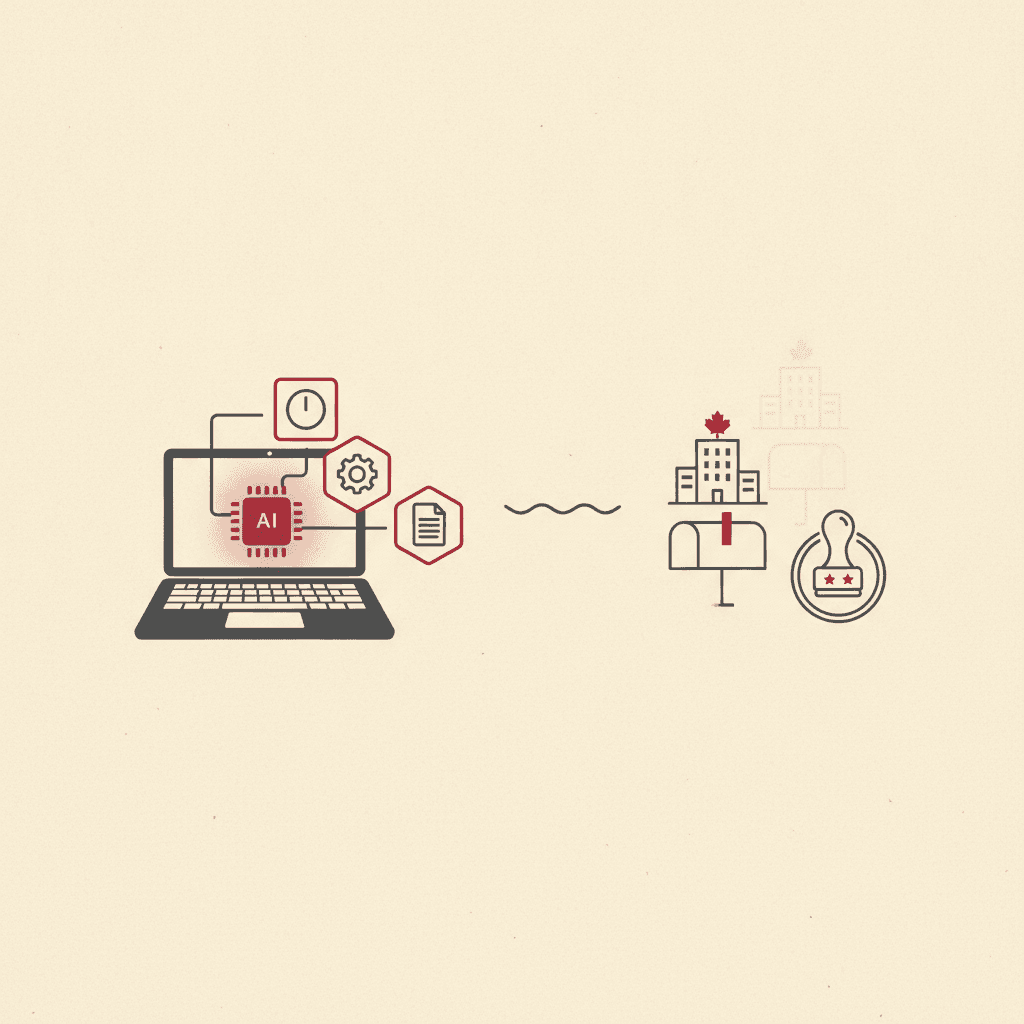
The honest answer is the part where a real institution has to trust that your business physically exists. AI can generate the work of a company. It cannot make your company real in the eyes of a bank, a government registry, or a payment platform. Three gaps in particular do not close on their own — and they are the ones that quietly stall a launch.
1. A business address that banks, governments, and platforms actually accept
Every real company needs an address that is not a prompt window. A bank's onboarding form, a provincial or state registry, Stripe, PayPal, Amazon, a business credit application — each one asks for a physical business address and then checks it against the others. AI cannot give you one, and it cannot be one.
The default move — using your home address — is where most solo founders get caught. In Canada, the moment you register a business name, that address becomes a public record anyone can search; it also lands on your tax file, your bank records, and every invoice you send. We walk through exactly where a home address ends up (and why a landlord or condo bylaw can turn it into a problem) in Can a sole proprietor use a business address, not home?.
The other default — a PO Box — usually fails for the opposite reason: banks and registries reject it because it isn't a real street address. What actually passes is a commercial street address in proper unit format, documented in your business name. For the specific test the CRA applies, see what the CRA actually requires of a business address; for how the available options compare, see our rundown of virtual business address providers in Canada.
This is the gap that surprises people most, because it feels like it should be solvable with software. It isn't. An address is a physical fact about your business, and every institution downstream treats it that way.
2. Registering or incorporating the business
AI can explain the difference between a sole proprietorship and a corporation, draft your bylaws, and walk you through the steps in plain language. What it cannot do is be the filer, sign as the incorporator, or serve as the registered office the filing requires.
Registering an entity is a legal act tied to a real jurisdiction and a real address. In Canada, incorporating provincially or federally means naming a registered office — a monitored physical address in the province, not a mailbox in the cloud. Our guide to incorporating in Toronto covers what that address requirement looks like in practice.
For cross-border founders the layer doubles. A Canadian resident who owns a US LLC is running two registration problems at once — a mandatory US registered-agent address the home cannot fill, plus a Canadian tax and mailing address — and the CRA and IRS treat the same entity differently. We unpack that mismatch in US LLC owned by a Canadian resident: which address goes where. AI is a genuinely useful research assistant for all of this; it is not a substitute for the filing itself or for the address the filing demands.
3. A business bank account — and the identity check behind it
The third gap is the one AI is structurally incapable of closing: know-your-customer (KYC) identity verification. Before a bank or payment processor opens a business account, it has to confirm that a real, identifiable person is behind a real business at a real address. That check exists specifically to stop an anonymous actor from spinning up a company — which is exactly the thing a language model cannot pass on your behalf, by design.
In practice, the bank pulls your registration record and cross-checks the address against your tax file and your application. A mismatch — home address here, a different address there, a PO Box somewhere else — gets flagged, and the account stalls. Canadian banks and online-first banks do accept a commercial virtual address when it is real and documented; we cover how that verification runs in opening a Canadian business bank account with a virtual address.
The pattern across all three gaps is the same. AI removes the labour of running a company. It does not remove the requirement that the company be a verifiable, real-world entity with a consistent address and an identifiable owner.
Closing the gap: the real-world layer under the AI stack
Here's the practical read for a one-person company in 2026. Your AI stack handles the output. The three gaps above — address, registration, banking — are the real-world layer underneath it, and they all trace back to a single dependency: a real, verifiable business address in a real city, consistent across every record, with your identity attached.
Get that one piece right and the rest lines up. Use the same commercial street address for your registration, your tax file, your bank account, and your client-facing invoices, and the cross-checks that stall solo founders simply pass. Get it wrong — a home address you didn't want public, a PO Box the bank rejects, three different addresses across three systems — and you spend launch week untangling paperwork instead of building.
This is the layer Auteur exists to cover: a real U.S. business address in one of nine U.S. cities, from Silicon Valley to New York, documented in your business name, with a photo of every envelope, scanning on request, and your home address kept off the public record. If you're setting up a one-person company and want the address settled before you register, reserve an address and use it on every record from day one.
FAQ
Can I really run a whole business with just AI in 2026? You can automate most of the work — content, support, research, scheduling, and first-pass bookkeeping — and survey data suggests a large share of solo founders already do. What you can't automate is the parts that require a real institution to verify your business exists: a registered address, the entity filing, and the bank's identity check. Those still need a real address and a real person.
Why won't a PO Box or my home address just work? A PO Box usually fails because banks and registries require a genuine street address, not a box number. A home address "works" legally in many cases, but in Canada it becomes a public record on the business registry the moment you register, and it propagates to your tax file, bank records, and invoices. A commercial street address in your business name avoids both problems.
Can AI help me open a business bank account? It can help you prepare — draft the documents, organize your records, explain what the bank wants. It cannot pass the KYC identity check for you, because that check is designed to confirm a real person and a real business at a real address. Getting your address consistent across your registration, tax file, and application is what actually smooths the process.
Bottom line
The one-person company is no longer a novelty — through 2026, AI made it a default. But the tools that run a business and the requirements that make a business real are two different layers. AI owns the first. The second — a business address institutions accept, a proper registration, and a bank account that clears its identity check — still lands on you, and it all rests on one verifiable address tied to your name.
If you're building alone and want that foundation set before your first filing, get a U.S. business address and use it consistently everywhere the real world asks where your business is.
This brief is general information for founders, not legal, tax, or financial advice. Confirm the specifics for your situation with a qualified professional and the relevant government registry before you file or open accounts.
Sources: Zoom + Upwork Small Business AI Report (via Forbes, May 2026) on scaling without hiring and AI's effect on admin work; Fortune (May 2026) on the scale of US solopreneurs; Carta Solo Founders Report (2025) on single-founder startup share; LinkedIn News on "founder" title growth. Figures are self-reported or aggregate survey data and are cited as directional.